
Prayer Time Madinah, Saudi Arabia
Live Prayer Timings for Madinah (Medina).
Fajr
Loading…
Dhuhr
Loading…
Asr
Loading…
Maghrib
Loading…
Isha
Loading…
Prayer Rak’ahs & Sunnah Guide
Quick reference for Fard, Sunnah and Qasr prayers
🌅 Fajr
2 Sunnah → 2 Fard
Qasr: 2 Fard
☀️ Dhuhr
4 Sunnah → 4 Fard → 2 Sunnah
Qasr: 2 Fard
🌤️ Asr
4 Sunnah → 4 Fard
Qasr: 2 Fard
🌇 Maghrib
3 Fard → 2 Sunnah
Qasr: 3 Fard
🌙 Isha
4 Fard → 2 Sunnah → 3 Witr
Qasr: 2 Fard
What are today’s prayer times in Madinah, Saudi Arabia?
Today’s salah (namaz) times in Madinah are Fajr at 5:14 am, Sunrise at 6:34 am, Dhuhr at 12:06 pm, Asr at 3:15 pm, Maghrib at 5:36 pm and Isha at 7:06 pm. These azan timings follow the official Umm Al-Qura method used across Saudi Arabia, the same timings announced by the Adhan at Masjid an-Nabawi (Masjid Nabawi). Madinah lies about 340 km north of Makkah, so its winter days are a little shorter: Fajr comes slightly later and Maghrib slightly earlier than in Makkah, and the opposite happens in summer.
What are today’s Sehri, Iftar and fasting times in Madinah?
Today’s Sunrise in Madinah is at 6:34 am and Sunset at 5:36 pm. During Ramadan, finish Sehri before Imsak at 5:04 am. The fast begins with the Fajr Adhan at 5:14 am from Masjid an-Nabawi and ends at Maghrib (Iftar) at 5:36 pm. Today’s fasting duration is about 12 hrs 32 min. In Ramadan, Masjid an-Nabawi also serves free Iftar to visitors in its courtyards, so many pilgrims break their fast there.
Madinah Prayer Times for the Next 30 Days
View the complete Madinah (Medina) prayer timetable for the next 30 days, with Fajr, Sunrise, Dhuhr, Asr, Maghrib and Isha for each day. It’s useful for planning Umrah and Ziyarat visits around prayer times at Masjid an-Nabawi. All timings follow the Umm Al-Qura method used in Saudi Arabia.
🕌 Masjid Nabawi (Masjid an-Nabawi) Iqamah Timings
The Iqamah at Masjid an-Nabawi follows the Adhan by a fixed gap, so you can plan to be in the Masjid before the prayer begins.
| Prayer | Typical Iqamah outside Ramadan | Typical Iqamah in Ramadan |
|---|---|---|
| Fajr | 15–20 min after Adhan | 20 min after Adhan |
| Dhuhr | 15 min after Adhan | 15 min after Adhan |
| Asr | 15 min after Adhan | 15 min after Adhan |
| Maghrib | 7 min after Adhan | 15 min after Adhan |
| Isha | 10 min after Adhan | 2 hours after Maghrib Adhan |
| Jummah | First Adhan 30 min before Dhuhr; Khutbah at Dhuhr time | Same |
| Janazah | Immediately after obligatory prayers | Same |
| Taraweeh | Not applicable | Immediately after Isha |
The Prophet ﷺ said that a prayer in his Masjid is better than a thousand prayers elsewhere, except Masjid al-Haram (Sahih al-Bukhari 1190). Arriving before the Iqamah helps you find a place, especially for Fajr, Maghrib and Jummah, when the Masjid and its courtyards fill quickly.
Explore Other Mosques in Madinah
Besides Masjid an-Nabawi, Madinah is home to some of the oldest and most visited mosques in Islam. Visitors on Ziyarat usually include these three. Tap Get Directions to open each one in Google Maps.
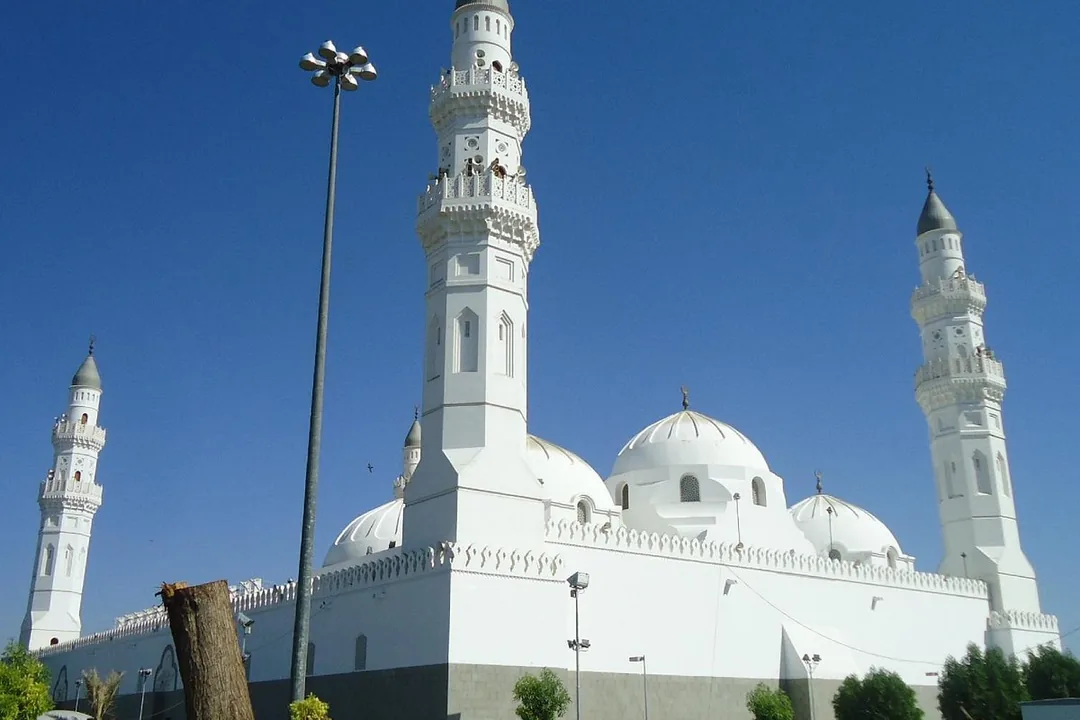
Quba Mosque (Masjid Quba)
📍 Location:
Quba district, about 3.5 km south of Masjid an-Nabawi
The first mosque built in Islam, founded in 622 CE when the Prophet ﷺ arrived in Madinah. The Prophet ﷺ used to visit it every Saturday, and he said that whoever purifies himself at home and then prays in Masjid Quba receives a reward like that of an Umrah (Sunan Ibn Majah 1412).
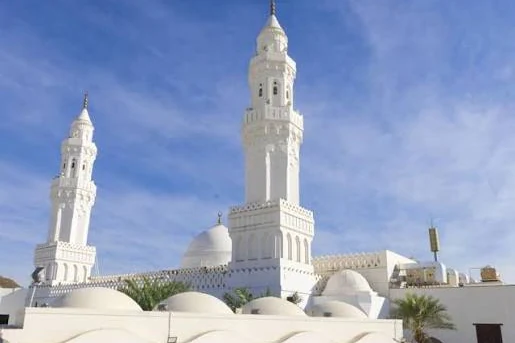
Masjid al-Qiblatain
📍 Location:
Bani Salamah area, north-west Madinah
The “Mosque of the Two Qiblas”, where the command came during prayer to turn the Qibla from Masjid al-Aqsa in Jerusalem towards the Kaaba in Makkah. It’s one of the most visited historical sites in Madinah.
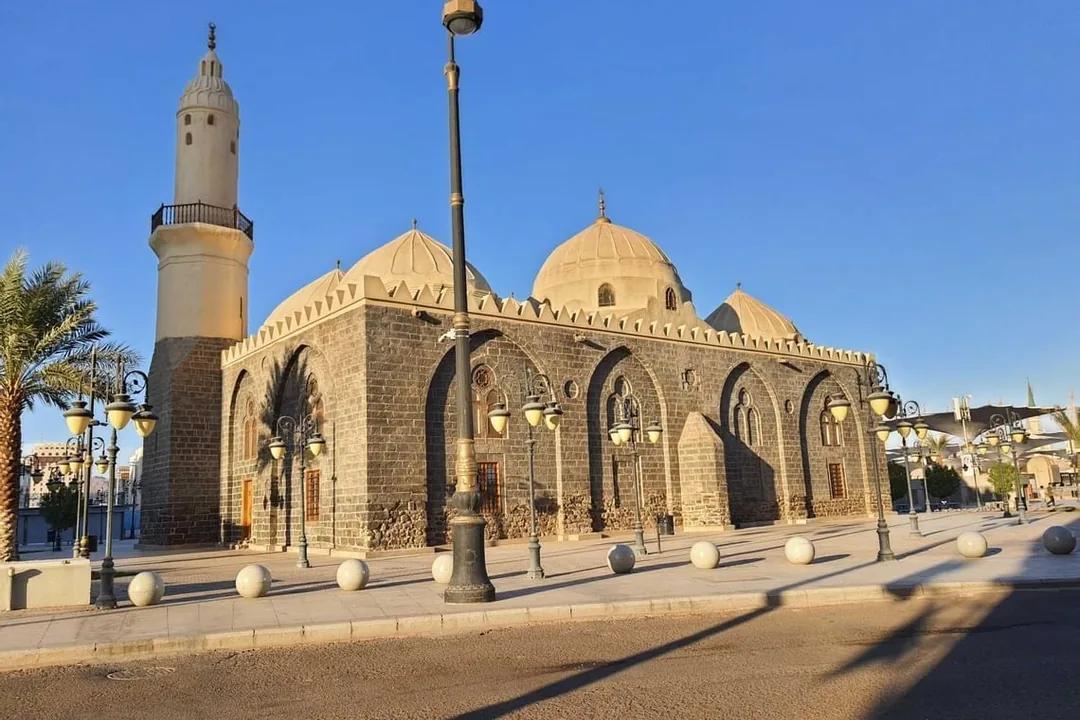
Masjid al-Ghamamah
📍 Location:
A few hundred metres south-west of Masjid an-Nabawi, opposite Bab al-Salam
Built where the Prophet ﷺ performed the Eid prayers and the prayer for rain (Salat al-Istisqa). Its name means “cloud”. The mosque was first built in the time of Umar ibn Abdul Aziz and restored in the Ottoman and Saudi eras.
🇸🇦 Explore Prayer Times Across Saudi Arabia
Explore accurate prayer times across Saudi Arabia’s major cities, or jump straight to a city near Madinah below.Jummah Prayer Time Madinah
Jummah in Madinah is held at Dhuhr time every Friday. At Masjid an-Nabawi, the first Adhan is called about 30 minutes before Dhuhr, and the Khutbah begins with the second Adhan at Dhuhr time. On Fridays the Masjid and its courtyards fill early, so most worshippers arrive an hour or more before. Neighbourhood mosques across Madinah usually begin their Khutbah 15–30 minutes after the Dhuhr Adhan.
Tahajjud Prayer Time in Madinah
Tahajjud can be prayed any time after Isha until Fajr, but the best time is the last third of the night. To find it, take the hours between Maghrib and Fajr in Madinah and divide them into three; the last part is the last third. During Ramadan, Masjid an-Nabawi holds Qiyam al-Layl in the last ten nights.
Ishraq Prayer Time Madinah (Salat al-Ishraq)
Ishraq is a voluntary (nafl) prayer offered once the sun has fully risen, about 15–20 minutes after sunrise in Madinah. Along with Chasht (Duha) and Tahajjud, it is one of the daily Nawafil times.
Ishraq time = Sunrise + 15 to 20 minutes
Duha Prayer Time Madinah (Salat al-Duha)
Duha (Chasht) is prayed later in the morning, after Ishraq time, and ends about 10–15 minutes before the Dhuhr Adhan in Madinah.
Salah Times in Saudi Arabia – Importance and Benefits
Prayer is one of the five pillars of Islam and holds great importance in the daily lives of Muslims. It builds spiritual connection of a Muslim to its Creator Allah. As stated in the Quran, in Surah Al-Baqarah Ayah 45 “Seek help through patience and prayer“—meaning you should actively turn to steadfast endurance and a deep, humble connection with Allah to ease your heavy burdens.
Importance of Performing Salah on Time
Performing Salah on time is one of the most important acts of worship in Islam and reflects a believer’s obedience and devotion to Allah (SWT). As Allah says in the Holy Quran:
“Indeed, prayer has been prescribed upon the believers at fixed times.” (Surah An-Nisa 4:103)
Offering each prayer within its prescribed time strengthens faith, brings peace to the heart, and helps maintain a disciplined and spiritually balanced life. By observing the correct prayer times every day, Muslims fulfill an essential obligation and keep their connection with Allah strong throughout the day.
Benefits of Performing Salah
Performing Salah strengthens a Muslim’s relationship with Allah (SWT), and develops spiritual discipline in daily life. It teaches punctuality, responsibility, patience, and consistency while reminding believers to place the worship of Allah above worldly matters. Regularly offering prayers at their prescribed times also nurtures piety (Taqwa), increases mindfulness of Allah, brings one heart at peace and planning chores between prayers helps Muslims lead a righteous and balanced life.
Calculation Method for prayer times
The prayer schedule displayed on this website is based on the Umm Al-Qura calculation method, which is widely used throughout Saudi Arabia. Prayer times in Madinah change gradually throughout the year due to seasonal changes and the varying length of daylight. During summer, earlier sunrises and later sunsets result in earlier Fajr and later Maghrib prayers, while winter brings later Fajr and earlier Maghrib times in KSA prayer times Madinah. This website updates the changes daily to provide accurate prayer timings all year round.
Prayer as a priority in Busy life styles
How to Plan to Offer Salah on Time?
- Check the daily prayer schedule each morning so you know the exact Salah times.
- Set prayer reminders or Azan alerts on your phone to avoid missing prayer times.
- Perform Wudu in advance whenever possible to be ready when the prayer time begins.
- Plan your work and daily activities around Salah so prayer becomes a priority, not an afterthought.
- Pray as soon as the prayer time starts instead of delaying it until the end of its prescribed time.
- Keep a clean prayer mat and prayer clothes ready to make it easier to pray without delay.
- Visit the mosque for congregational prayers whenever possible, especially for Fajr, Maghrib, Isha, and Jumu’ah.
- Make Duas and ask Allah (SWT) for consistency in performing every Salah on time.
- Keep a schedule of Morning and Evening Azkar
Frequently Asked Questions
What time is Fajr prayer in Madinah today?
Fajr prayer in Madinah today begins at 5:14 am. Prayer times are updated daily based on the Umm Al-Qura calculation method used in Saudi Arabia.What are Masjid Nabawi prayer times today?
Masjid Nabawi follows the Umm Al-Qura timings shown at the top of this page, which update automatically every day. The Iqamah follows each Adhan by 7–20 minutes.
Are prayer times in Madinah the same as in Makkah?
No. Madinah is about 340 km north of Makkah, so its times differ by a few minutes. In winter, Fajr is slightly later and Maghrib slightly earlier than in Makkah, and the opposite happens in summer.
What is the difference between Adhan and Iqamah time?
The Adhan is the call that marks the start of prayer time. The Iqamah is the second call, when the congregation stands for prayer. At Masjid Nabawi, arrive before the Iqamah to find a place.
When is the Iqamah at Masjid an-Nabawi?
The Iqamah usually follows the Adhan by 15–20 minutes at Fajr, 15 minutes at Dhuhr and Asr, 7 minutes at Maghrib and 10 minutes at Isha. Gaps change slightly in Ramadan (see the Iqamah table above).
Is Jummah time the same as Dhuhr time in Madinah?
Jummah replaces Dhuhr on Friday and is held at Dhuhr time. The Khutbah starts with the Dhuhr Adhan at Masjid Nabawi, and the first Adhan comes about 30 minutes earlier.
Does Isha time change in Ramadan in Madinah?
Yes. During Ramadan, the Umm Al-Qura calendar sets Isha 2 hours after Maghrib, instead of the usual 90 minutes, to allow time for Iftar before Isha and Taraweeh.
How do Madinah prayer times change through the year?
They shift a little every day with the sun. Fajr is around 5:35 AM in December and around 4:10 AM in June, while Maghrib moves from about 5:30 PM in winter to after 7 PM in summer.
What is the Qibla direction in Madinah?
The Qibla from Madinah is about 176°, almost due south, towards Masjid al-Haram in Makkah, about 340 km away.
Do I need a permit to pray in the Rawdah (Riyaz ul Jannah)?
Yes. Prayer in the Rawdah Sharif requires a free timed permit booked through the official Nusuk app. Book your slot around the prayer times, and arrive early, as slots fill quickly.
What timezone is used for Madinah prayer times?
Arabia Standard Time (UTC+3). Saudi Arabia doesn’t use daylight saving time, so the clocks never change.